
The most consequential customer conversation in luxury travel this year is one no human is in.
A household worth eight figures decides it wants three weeks in the polar summer, or a villa season in the Aegean, or the suite at the top of the ship. Increasingly, the research that follows is not done by them. It is done by software acting for them — an AI assistant that queries, compares, filters, and returns a short list. By the time a human looks at options, the options have been chosen.
This is no longer a forecast. Phocuswright’s latest research calls it the fastest behavioral shift in travel it has measured in a decade: 56 percent of U.S. travelers used AI for planning, booking, or in-trip assistance in the past twelve months — up from 33 percent a year earlier. Forty percent say they would let an AI assistant handle flight and hotel bookings on their behalf. General search — the front door of travel for twenty years — has fallen from 51 percent to 36 percent as the most-used research resource.
The front door of your market is being replaced. The new one does not open for advertising.
What an agent actually does
Understand the machine you are now marketing to, because it behaves nothing like the customer you built your funnel for.
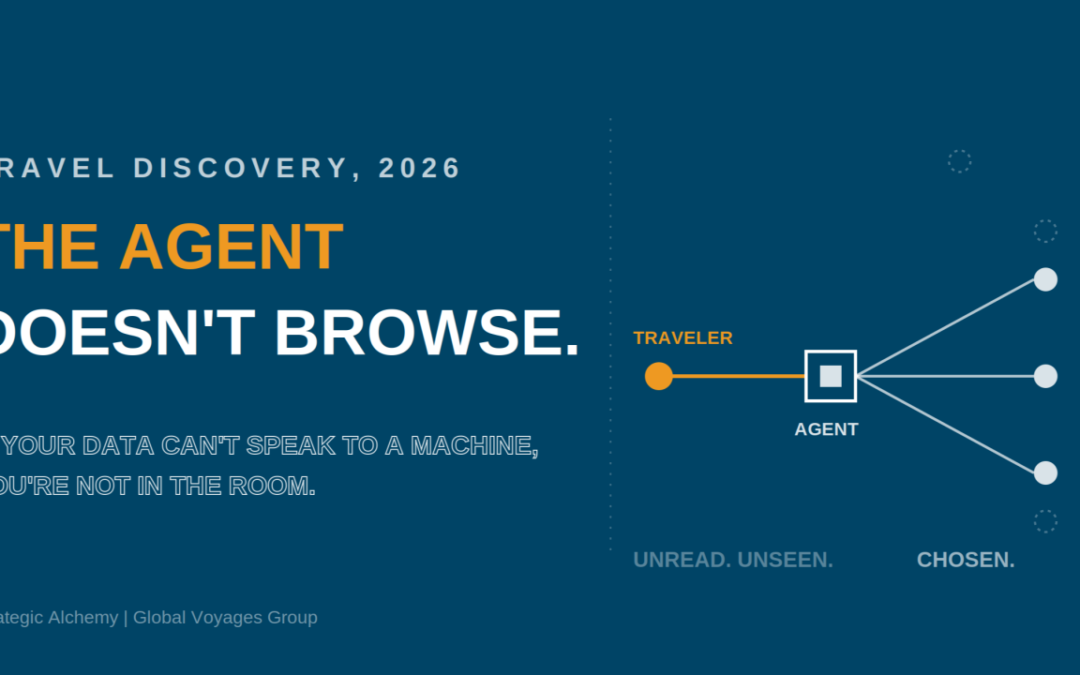
An agent does not browse. It does not linger on your photography, absorb your brand campaign, or wander from an inspiration piece into your booking path. It does not see your retargeting. It is not nostalgic about your logo. It queries structured data, applies its principal’s constraints — dates, party size, standards, budget shape — and returns a decision set.
Everything about the modern marketing funnel assumed one resource: human attention. The agent’s entire purpose is to remove human attention from the process. What survives contact with an agent is not the best-marketed product. It is the best-described one — complete, structured, current, verifiable.
If your data cannot speak to a machine, you are not losing the argument. You are absent from the room where it happens.
I have watched the front door move before
Four decades in the cruise industry means I have lived through every relocation of travel’s front door: from retail agency networks, to call centers, to the web, to online agencies and metasearch. The pattern never varied. Each time, the operators who treated the new door as just another channel — a line item, a test budget, someone’s side project — spent the following decade paying rent to whoever took it seriously first.
Whoever controls the front door taxes everyone behind it.
The agent era is the next relocation, and it is moving faster than any shift before it — adoption nearly doubled in a single year. Every operator in this industry already knows the clock that matters, because we sell perishable inventory: the cabin that sails empty is revenue gone forever, unrecoverable at any price. The window for positioning ahead of machine-mediated discovery runs on the same relentless countdown. It does not close gradually. It departs.
What a machine needs from you — and what it takes away
Strip the problem to first principles. Agent-mediated discovery changes two things at once, and most brands are watching only the first.
The first: to be chosen by a machine, you must be legible to a machine. Product data, availability, pricing, attributes — structured and complete. This is the part the industry is beginning to discuss.
The second is quieter and, for marketers, more dangerous: the agent destroys the behavioral trail your acquisition system feeds on. When software does the browsing, there is no human wandering the web leaving signals — no site visits to retarget, no searches to bid on, no engagement to model. The probabilistic targeting machine loses its fuel exactly as the free funnel loses its traffic. Cumulative Effect, running against you: every quarter of agent adoption, the platforms know less about who is in your market.
Which forces the question that matters: when the machines mediate discovery and the behavioral exhaust disappears, how do you still know — and reach — the households that are qualified for what you sell?
The counterweight is deterministic
You cannot out-bid your way back into an agent-mediated journey. You can stand outside it.
The one asset the agent cannot take away is direct, verified knowledge of who your market is: the wealth-qualified households themselves, reachable through owned channels — permissioned email, direct mail, verified custom audiences — that do not require the front door’s permission. Deterministic identity is the counterweight to machine-mediated anonymity. When you know exactly who is qualified, you do not need to wait for their agent to find you; you are already in the household’s field of view before the query is ever typed.
That is the design logic of the Bristol Affluent Traveler Marketing Database at Global Voyages Group: a deterministic, wealth-verified map of the affluent U.S. travel market, built to function as a brand’s owned demand asset in precisely the environment where rented visibility fails.
The brands that hold both positions — machine-legible product data and machine-independent audience data — will be present in the room and standing outside it. Everyone else is trusting the algorithm to remember them.
So what — and what now
Three moves, in order.
First, audit your machine legibility. Have someone ask the major AI assistants to plan the trip you sell — your itinerary, your category, your standard. Read what comes back. If you are absent or misdescribed, that is your acquisition future without intervention.
Second, measure your behavioral dependence. Estimate what share of your marketing engine runs on human browsing signals — retargeting, lookalikes, engagement-based bidding. That share is your exposure as agents absorb the journey.
Third, build the machine-independent channel now. Owned, verified, wealth-qualified audience data, deployed through channels you control. It is the only part of your acquisition system that gets stronger, not weaker, as the agents take over the front door.
The front door has moved four times in my working life. This is the fifth, and the fastest. The operators who won the earlier moves were never the largest. They were the earliest to take the new door seriously.
Onward.