
Somewhere in your next budget cycle, a line item is going to move against you. Customer acquisition cost will drift up. The marketing dashboard will attribute it to seasonality, competition, market conditions. The CFO will see something simpler: the same growth now costs more money.
Both will be describing the same event. Only one of them will name it correctly.
I spent years inside that dynamic tension — the CFO reading the raw arithmetic, the CMO defending the model behind it. The tension is healthy. It is also a signal: when the two readings of the same number diverge, a CEO should treat it as the first indication that a deeper look is warranted. Every time I sat in that room, the company came out better for the argument.
For roughly two decades, every travel brand’s acquisition economics ran on a quiet subsidy: a meaningful share of demand arrived free. A traveler searched, your content ranked, they clicked, you captured the relationship. Organic discovery did unpaid work at the top of the funnel, and every CAC calculation silently depended on it.
That subsidy is ending. Not gradually. Structurally.
The quiet subsidy, withdrawn
AI is absorbing the top of the funnel. Search queries increasingly end in a generated answer rather than a click. Industry forecasts describe travel discovery, comparison, and booking migrating to AI agents acting on the traveler’s behalf. Every journey that ends inside an answer is a small withdrawal from your funnel: one fewer site visit, one fewer email capture, one fewer retargeting signal, one fewer relationship that began at zero cost.
The demand does not disappear. The affluent traveler is still planning the voyage, the villa, the season in the sun. What disappears is the free path between their intent and your brand.
Demand that used to arrive unpaid must now be bought. And here is the compounding problem: everyone must buy it at the same time.
The auction problem
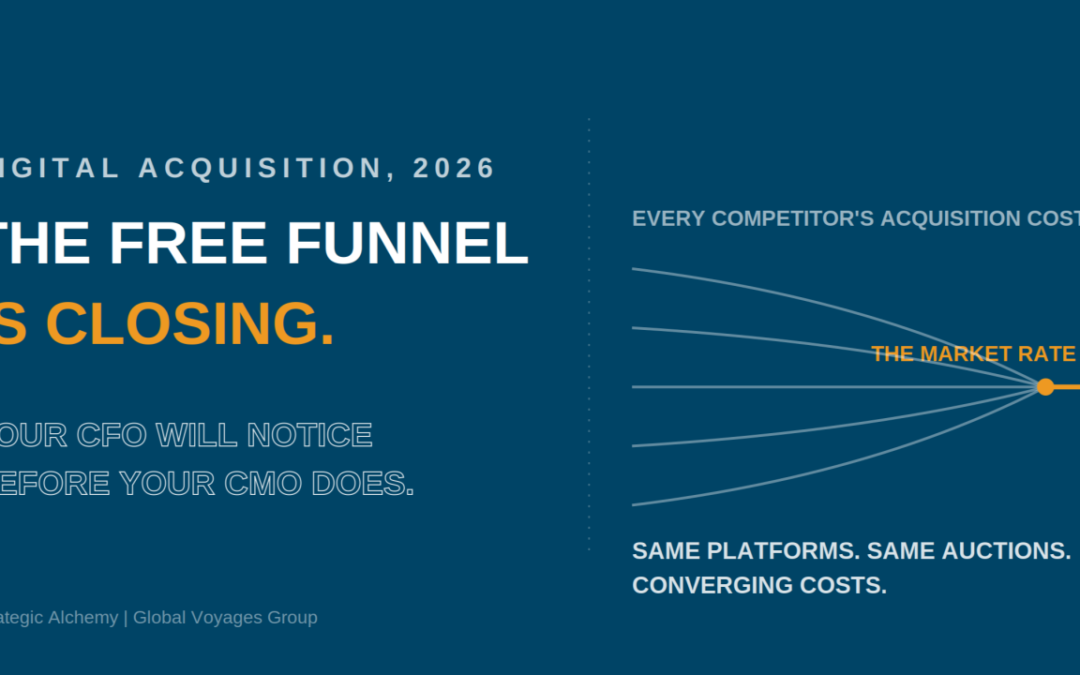
When the free channel narrows, every brand in the category is pushed into the same paid auctions simultaneously. Same platforms. Same bidding systems. Same targeting menus. The mechanics of an auction do the rest — more bidders competing for the same inventory means the clearing price rises for everyone.
Follow that logic one step further, because this is the part most marketing plans have not priced in: when every competitor rents the same acquisition machine, acquisition stops being a competitive advantage. Your reach is their reach. Your lookalike model runs on the same engine as theirs. Costs converge toward a market rate, and no budget, however large, buys durable differentiation — because whatever you rent, they can rent.
Rented precision returns to the landlord. Every quarter, the rent goes up.
The luxury multiplier
For brands selling to affluent travelers, two conditions make this squeeze tighter still.
First, the high-net-worth buyer is the least trackable person in the market. Privacy tools, ad blocking, opt-outs, assistants that browse on their behalf — the wealthiest households remove themselves from behavioral tracking at exceptional rates. The platforms’ probabilistic models are weakest precisely where your revenue is concentrated.
Second, elite travelers are loyal to the category, not the logo. The same household moves between the expedition ship, the safari, the private villa, the wine-country estate. Their in-market signal lives across the whole category — which means no single brand’s first-party data can see it. Your past-guest file shows you your slice of their travel life and nothing else.
Put the two together: your most valuable buyer is the least visible, at exactly the moment visibility became expensive.
What cannot be rented
Strip acquisition to first principles. Every campaign reduces to four inputs: reach, creative, timing, and audience.
Reach is rented — the platforms own it. Creative is imitable — excellence gets copied in a quarter. Timing is algorithmic — the machines set it for everyone. That leaves one input, and only one, that a competitor cannot lease from the same vendor tomorrow: the audience itself. Who you spend against.
A verified, owned, wealth-qualified audience is the single input in the acquisition equation that behaves like an asset instead of an expense. It does not reprice at auction. It does not thin as tracking erodes — a fact worth holding against the backdrop of 736,000 new U.S. millionaires minted last year alone. And it compounds: every campaign run against owned data teaches you something the platforms keep for themselves when you rent.
This is the reasoning behind the Bristol Affluent Traveler Marketing Database at Global Voyages Group — a deterministic, wealth-verified map of the affluent U.S. travel market that a brand deploys as its own asset, not a platform’s rental inventory. Not a better way to buy clicks. A way to need fewer of them.
For a CEO, the question is ultimately a balance-sheet question, not a media question: does your company own an audience asset, or does it rent one? One appreciates. The other inflates.
So what — and what now
Three moves, in order of urgency.
First, ask your CFO — not your CMO — for the blended acquisition cost trend over the last three years. Strip out the attribution narrative and look at the raw arithmetic: dollars in, customers out. If the ratio is deteriorating, the subsidy withdrawal has already reached your P&L.
Second, inventory your audience assets honestly. Separate what you own (verified households, permissioned relationships, qualified lists) from what you rent (platform audiences, lookalikes, retargeting pools). Most brands discover the owned column is far thinner than the org chart assumes.
Third, redirect before the market rate forces you to. Every dollar moved from renting reach to building owned, wealth-verified audience is a dollar that stops repricing against you.
The free funnel financed two decades of growth strategy. It was never a permanent feature of the market — it was an era. Eras end. The brands that recognize the closing early will buy their independence at today’s prices. Everyone else will rent, at tomorrow’s.
Onward.