
Every multigenerational trip in the luxury travel market has an operating officer. One person who researches the options, reconciles the calendars, manages the parents’ expectations and the teenagers’ moods, negotiates the budget, and presses the booking button.
That person is almost always Gen X. And the entire marketing apparatus of luxury travel is built to look past them.
Campaign briefs in this category aim at two generations: Boomers, because they hold the wealth today, and Millennials, because they are the future. Gen X — roughly 45 to 60 years old, running the households where three generations’ travel decisions actually get made — sits in the gap between those two briefs, addressed by neither.
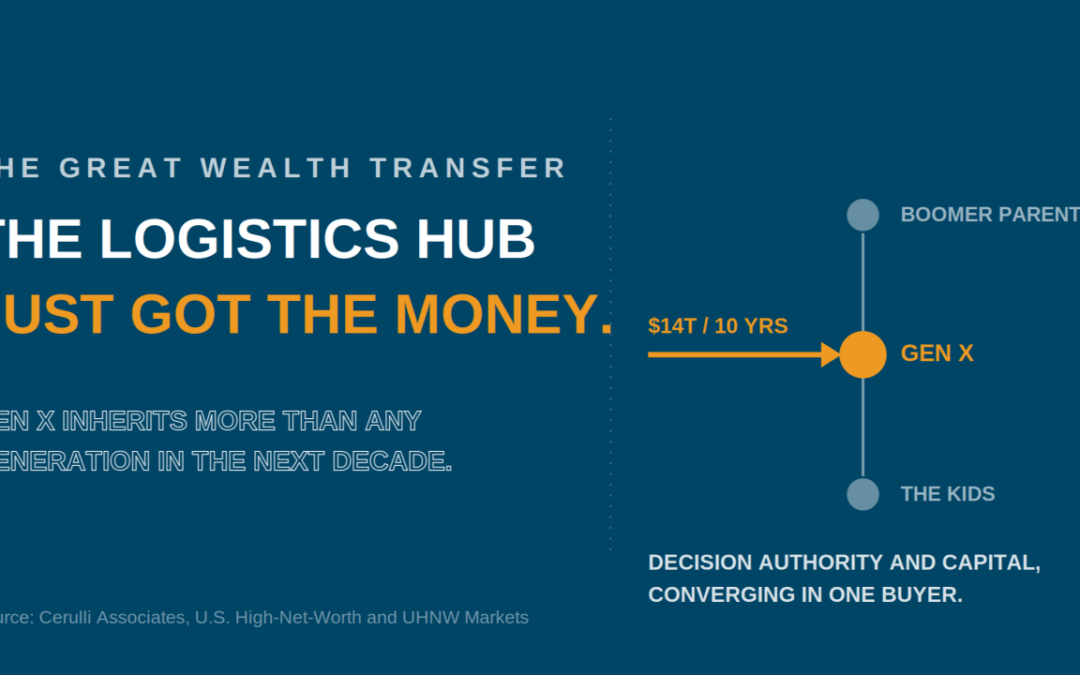
Here is why that gap just became expensive. According to Cerulli Associates, Generation X will inherit more than any other generation over the next ten years: roughly $14 trillion, against $8 trillion for Millennials — nearly $1.4 trillion arriving every year, the leading edge of the $124 trillion Great Wealth Transfer running through 2048.
Read those two facts together. The person who already holds the decision authority in the multigenerational household is now the person receiving the money. Authority and capital are converging in a single buyer — and the category’s marketing is aimed on either side of them.
The household’s operating officer
Strip the multigenerational travel purchase to first principles and ask: who actually decides?
Not the Boomer grandparents, though they often fund it and their preferences carry weight. Not the grandchildren, though the trip is frequently organized around them. The decision — the destination shortlist, the brand comparison, the cabin configuration, the timing, the final commitment — runs through the Gen X coordinator in the middle. They are the household’s researcher, negotiator, treasurer, and booking engine.
The industry has always known this quietly. Ask any seasoned reservation leader who is actually on the phone for the three-generation booking. It is the daughter or son in their fifties, executing on behalf of everyone.
Marketing has treated this person as a conduit: the one who transmits the campaign to the real customer. The wealth transfer ends that framing. The conduit is becoming the capital.
Why your targeting cannot see them
Now the structural problem — and it is the same one that runs through everything I have written in this series.
An inheritance is a wealth event, not a behavior. It produces no click, no search history, no engagement signal, no lookalike resemblance to anything that came before. The platforms’ probabilistic models — built entirely on behavioral exhaust — are blind to it by design. A household that quietly crossed into seven-figure liquidity last quarter looks, to the algorithm, exactly like it looked the quarter before.
Your loyalty file is blinder still. Many of these Gen X buyers have decades of history with luxury travel brands — as the kids in the connecting cabin. The file remembers them as children on their parents’ booking. It has no mechanism for noticing that the child in the manifest is now the decision-maker with the estate.
Age-based targeting, the industry’s default answer to generational strategy, makes it worse: it buys the whole 45-to-60 demographic to reach the fraction receiving wealth, paying for millions of impressions against households that inherited nothing. The event that matters — verified wealth arriving in a specific household — is invisible to every probabilistic tool in the stack.
Only deterministic, wealth-verified data can see a wealth event. That is not a marketing preference. It is the physics of the problem.
The convergence is the opportunity
For brands, the Gen X moment is not a demographic campaign. It is a repositioning of who the buyer is.
The offer architecture changes: the multigenerational product should be designed and priced for the coordinator — ease, logistics, time protection, one point of control — even when the funding is partly the grandparents’. The creative changes: this buyer is not persuaded by aspiration imagery aimed at their parents or their children; they respond to competence, candor, and respect for their scarcest asset, which is not money but bandwidth. And the audience changes: from renting an age range to knowing, deterministically, which households hold both the authority and the newly arrived capital.
Seeing that household — wealth-verified, current, at the individual level rather than the demographic level — is precisely what we built the Bristol Affluent Traveler Marketing Database to do. The generational story is the headline. The household-level wealth event is the target.
So what — and what now
Three moves.
First, re-audit who your multigenerational product actually serves. If the brief describes the grandparents’ dream and the grandchildren’s memories but not the coordinator’s burden, you are marketing to the passengers and ignoring the buyer.
Second, separate age from wealth in your audience thinking. The question is not “how do we reach 45-to-60-year-olds?” It is “which households just experienced a verified wealth event?” Those are different lists, and only one of them converts.
Third, move before the category re-aims. Every competitor’s brief still points at Boomers and Millennials. A decade-long, $14 trillion transfer is arriving into the hands of the least-marketed-to generation in the category. Gaps like that do not stay open.
The travel industry spent forty years learning to sell to the people at the head of the table. The money is moving to the person who booked the table, confirmed the headcount, and drove everyone there.
Onward.