
Every operator of my generation learned the same reflex: booms end. You ride the expansion, you bank the yield, and you keep one hand on the throttle because the cycle always rolls over. That reflex protected a lot of P&Ls over forty years.
Right now, it is the most expensive instinct in luxury travel.
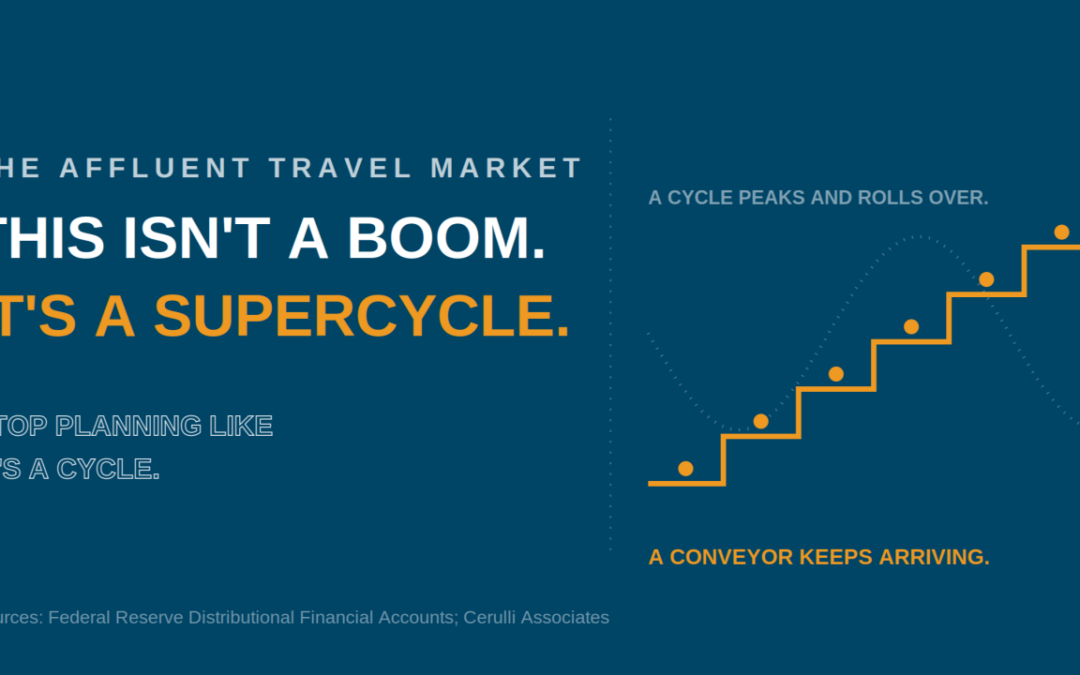
Because what the affluent travel market is experiencing is not a boom in the historical sense — a temporary economic expansion lifting all boats until it peaks. It is something structurally different: a demographic conveyor, moving wealth into prime leisure-spending years on a schedule that was set decades ago and cannot be interrupted by a bad quarter. Brands planning against a 12-to-18-month cycle are planning against the wrong clock.
The conveyor, not the wave
Look at where the wealth actually sits. Federal Reserve data as of the first quarter of 2026 puts Baby Boomers’ share of total U.S. household net worth at 51.6 percent — with the Silent generation holding another 11.3 percent. Nearly two-thirds of the nation’s wealth is held by the generations in, or entering, their prime leisure years. Add Gen X’s 26.1 percent, and the cohorts on the travel-spending side of the ledger control more than three-quarters of American household wealth.
Now watch the movement, because this is what makes it a conveyor rather than a wave. The trailing edge of the Boomer generation — its largest birth cohorts — is still crossing into the prime spending window. Millions of households arrive at that threshold every year, and will keep arriving for years to come. Directly behind them, older Gen Xers are entering their own peak wealth-consolidation and leisure years — while receiving, per Cerulli, more inherited wealth over the next decade than any other generation: roughly $14 trillion.
A wave crests once. A conveyor keeps delivering. That is the difference, and it changes the planning horizon for everyone selling to this market.
Paycheck cycles versus portfolio cycles
There is a second structural break from history, and it explains the resilience that has surprised so many forecasters: this spending does not run on income. It runs on balance sheets.
Past travel booms depended on current earnings — which is why they died with recessions. Today’s affluent traveler draws on decades of compounded asset growth in equities and real estate. Their spending capacity is insulated from the macroeconomic crosswinds that used to end cycles, which is why they commit confidently to high-ticket travel two and three years out — the world cruise, the extended expedition itinerary, the multigenerational season — through headlines that would have frozen bookings in any earlier era.
When the customer plans three years ahead and the operator plans eighteen months ahead, the operator is the short-term thinker in the relationship. Sit with that.
The caveat I have earned the right to state
Every structural argument owes you its assumptions, and mine is explicit: this holds absent a major interruption — geopolitical, pandemic, economic. I do not state that caveat as a formality.
On the morning of September 11, 2001, I was an executive vice president at Holland America Line with nearly fifteen thousand guests scheduled to fly to and from our ships around the world. By mid-morning the FAA had grounded every commercial flight in North America for the first time in history. One of our ships spent weeks in Alaska serving as a hotel because our guests could not get home. Nineteen years later, I watched the advisories escalate through March 2020 until the seas went quiet altogether — an entire industry’s revenue at zero, with no restart date. I wrote about navigating both in Hard Ships. Disruption is not a footnote to me; it is the fog I map for a living.
But respecting disruption is different from planning for permanent winter. Here is what both interruptions ultimately proved: the demand came back, because the demographic arithmetic underneath it never left. A conveyor pauses. It does not reverse. With the assumption stated, my working assessment — operator judgment, not a sourced forecast — is sustained affluent-travel spending growth in the range of three to five percent annually, carried by that conveyor for years, not quarters. The window is wider than any this industry has operated in.
The tide is lifting everyone. That is the trap.
Here is the strategic danger of a market this good: broad growth flatters average strategy. When the entire tide rises, every brand’s numbers improve, and every leadership team is tempted to read outperformance as validation. Don’t confuse the tide with the swimmer.
The Cumulative Effect never stops running, though. As the structural growth persists, share filters — quarter by quarter — toward the brands whose product, pricing, and marketing are genuinely aligned with this buyer: time optimization over discounting, certainty over promotion, exclusivity over volume. The laggards will not feel it as an event. They will simply wonder, three years from now, why a market that kept growing stopped growing for them.
Which is why the audit matters now, while the tide is still covering everyone’s positioning. Three questions for your next planning cycle: Does our capital and marketing allocation reflect a multi-year window, or a quarterly reaction? Do our pricing architecture and product tiers capture what this buyer actually values — time, certainty, access — or are we still discounting to a price-sensitive customer who is no longer the one buying? And which parts of our portfolio are genuinely differentiated enough to take disproportionate share when the broad tide levels?
There is a data version of the same audit. A longer window rewards the brands that can see the whole qualified market as it moves through it — every household crossing into the prime spending years, not just the fraction already in a booking file. That current, wealth-verified view of the market is what we built the Bristol Affluent Traveler Marketing Database to provide: the conveyor, visible at the household level.
So what — and what now
Three moves.
First, re-length your horizon. Take the three-year plan and ask what changes if the demand window runs seven. Capacity, product development, and audience assets all price differently against a supercycle than against a cycle.
Second, reprice for the buyer you actually have. Every dollar of promotional discounting aimed at this market is margin surrendered to a customer who was never price-shopping. They are time-shopping and certainty-shopping.
Third, position for the filtering. The undifferentiated share gains of the rising tide are on loan. Decide now which categories, products, and audiences you intend to own when the sorting starts — because it has already started.
Don’t get caught short in your strategic horizon. The market is handing this industry the widest window it has ever had. Width is not the same as forever — and the brands that treat the window with respect will be the ones still standing in it when it narrows.
Onward.