
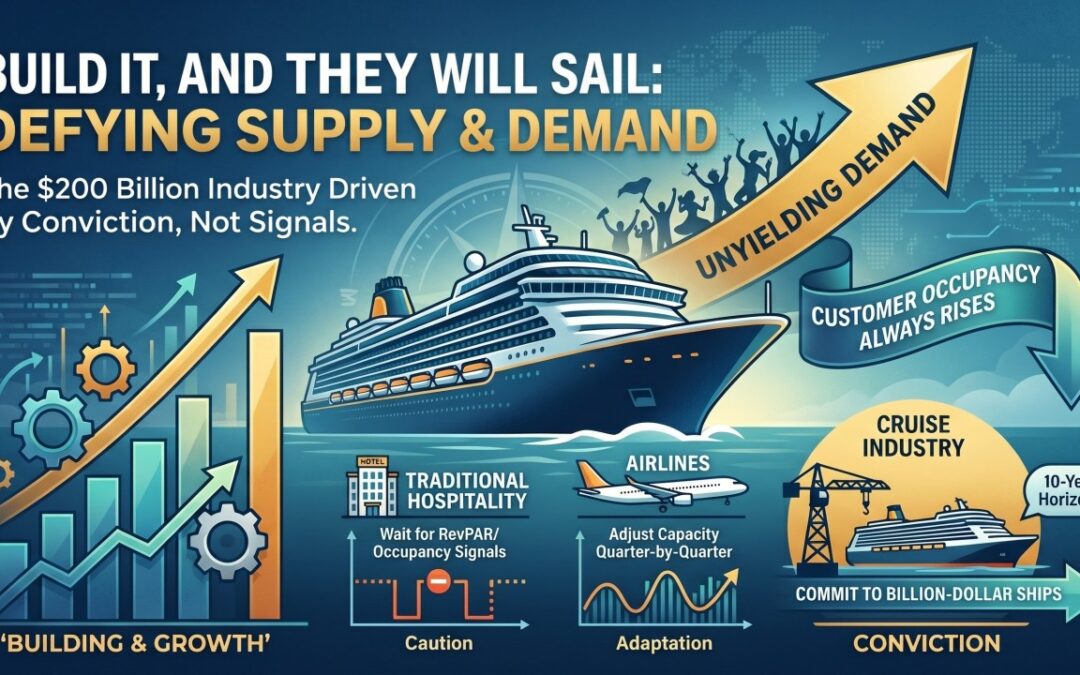
What if I told you there’s a $200 billion global industry that makes its biggest capital decisions — billion-dollar commitments with decade-long horizons — without waiting for demand signals?
No market studies. No pressure on inventory. No “let’s see if the numbers justify it.”
Just conviction.
The cruise industry doesn’t follow the conventional hospitality playbook. Hotels wait for RevPAR pressure and occupancy thresholds before breaking ground. Airlines adjust capacity quarter by quarter based on load factors. Resorts study absorption rates before adding rooms.
Cruise lines order ships.
And the customers always come.
The 41-Year Proof
CLIA’s just-released 2026 State of the Cruise Industry Report — presented this week at Seatrade Cruise Global in Miami — lays out a growth story that would strain credulity in any other sector.
In 1985, 1.9 million people took an ocean cruise. In 2025, 37.2 million did. That’s a nearly 20x increase across four decades, and 2025 set new passenger records in every single quarter.
The pandemic — the most severe disruption the industry has ever faced — barely registers as a deviation in the long arc. After a voluntary, industry-wide operational shutdown that produced zero revenue for 15 months, passenger volumes recovered to pre-pandemic levels within two years and have since surged 25% beyond them.
Post-pause, each year has been a new record: 20.4 million (2022), 31.1 million (2023), 34.6 million (2024), 37.2 million (2025). The forecast calls for approximately 42 million by 2029.
Every wave of new tonnage has been absorbed. Every single time.
Supply-Led by Design
Most industries are demand-led. Cruise is supply-led. This isn’t a bug — it’s the operating model.
A cruise ship takes 3–5 years to build and costs between $500 million and $1.6 billion. The decision to order one is made half a decade before the first guest boards. There is no test market. There is no soft opening. You commit the capital, you build the vessel, and you fill it.
The current CLIA member orderbook tells you how confident the industry remains: 60 new ocean-going ships on order through 2037, adding 193,000 lower berths — a 29% capacity increase — representing $71 billion in committed investment. In 2026 alone, 8 new ocean-going vessels enter service, adding 20,600 berths and $6.6 billion in capital.
Among them: Royal Caribbean’s Legend of the Seas (250,800 GT, 5,610 berths, $1.6 billion) and MSC’s World Asia (205,700 GT, 5,400 berths, $1.2 billion). These are not cautious bets. These are declarations of structural confidence.
Why the Demand Reservoir Never Runs Dry
Here’s the structural insight that explains why “build it and they’ll come” works in cruising when it would be reckless in most other sectors:
Cruising represents just 2.7% of the global travel and tourism sector.
Read that again. Under three percent. The industry isn’t trying to grow its share of a small pie. It’s converting a tiny additional fraction of a massive global leisure travel market — one measured in billions of trips and trillions of dollars. At that penetration level, there is always latent demand available to absorb incremental capacity.
The CLIA Cruise SPI survey data (December 2025) confirms the depth of this reservoir:
- ~90% of past cruisers intend to cruise again — the highest level ever recorded
- 76% of people who have never cruised are open to their first cruise — up from 55% in 2020
- 78% of cruisers and cruise-curious travelers are likely to book within two years — on a sustained upward trend
- 28% of repeat cruisers take two or more cruises per year
The conversion engine is working. The top reasons people chose a cruise over other vacation types? Multi-destination access (22%) and value for money (15%). These are durable, structural advantages that don’t erode as capacity grows — they strengthen, because more ships mean more itinerary variety, more price points, and more entry ramps for new-to-cruise travelers.
Supply Drives Infrastructure — Not the Reverse
Here’s the second half of the dynamic that most observers miss: it is the expansion of cruise capacity that drives the expansion of port infrastructure — not the other way around.
In virtually every other sector, infrastructure precedes commerce. You build the airport, then airlines add routes. You build the convention center, then events come.
In cruising, the sequence is reversed. Ships get ordered. Ships get built. Ships need berths. Then ports invest.
The evidence is everywhere:
- PortMiami: $756.8 million committed for six new cruise terminals over the next five years
- Nassau Cruise Port: $300+ million redevelopment to accommodate three Oasis-class ships simultaneously
- Seward, Alaska: $137 million new cruise port backed by Royal Caribbean’s 30-year commitment
- Port of Los Angeles: Record 1.6 million cruise passengers in 2025; new world-class Cruise Center selected for development
- Global Ports Holding: $250+ million in construction underway across five Caribbean and European destinations
The iron drives the concrete. The ships create the gravitational pull that reshapes the shoreside ecosystem.
And the economic multiplier reinforces the cycle. CLIA’s 2024 Global Economic Impact Study shows $198.8 billion in total economic impact — the highest on record, 29% above 2019. That impact supported 1.8 million jobs and $60 billion in wages worldwide. When 64% of cruisers stay at least one night pre- or post-cruise, and 61% return to destinations they first visited by cruise, the business case for port infrastructure investment becomes self-reinforcing.
The Logic Chain
The cruise industry’s supply-demand dynamic operates as a virtuous cycle:
Cruise lines commit billions to new capacity years in advance → they can do so confidently because cruise captures under 3% of global leisure travel, leaving a vast demand reservoir → demand has absorbed every capacity increase for 41 consecutive years → that new capacity triggers billions in port and terminal infrastructure investment → which in turn enables the next generation of ships → and the cycle continues.
This is an industry where supply creates its own demand — because the addressable market is so much larger than the industry’s current share. And that supply simultaneously creates the infrastructure ecosystem that supports it.
Forty-one years. 1.9 million to 37.2 million. Occupancy consistently at or above 100%. $71 billion in ships on order. Nearly 90% of past cruisers saying “I’ll be back.”
Build it and they will sail. Onward!
About the Author
David Giersdorf is the Founder of Global Voyages Group, a strategic advisory firm serving the cruise industry. A forty-year cruise industry veteran, he is the author of Hard Ships and the creator of the Strategic Alchemy platform. “I’ve invested over 100,000 hours—ten times Malcolm Gladwell’s 10,000-hour rule—building, leading, acquiring, and selling businesses across the global cruise and travel industry and the marketing and data sectors. My career spans operational leadership, strategic transformation, M&A, and turning around underperforming assets into market leaders. I’ve led teams from dozens to thousands, managed P&Ls, driven billions in revenue, and navigated organizations through growth, crisis, and fundamental reinvention. I now advise executives and organizations on strategy, leadership, resilience, and transformation through complexity, helping leaders move from survival to systematic excellence.”