
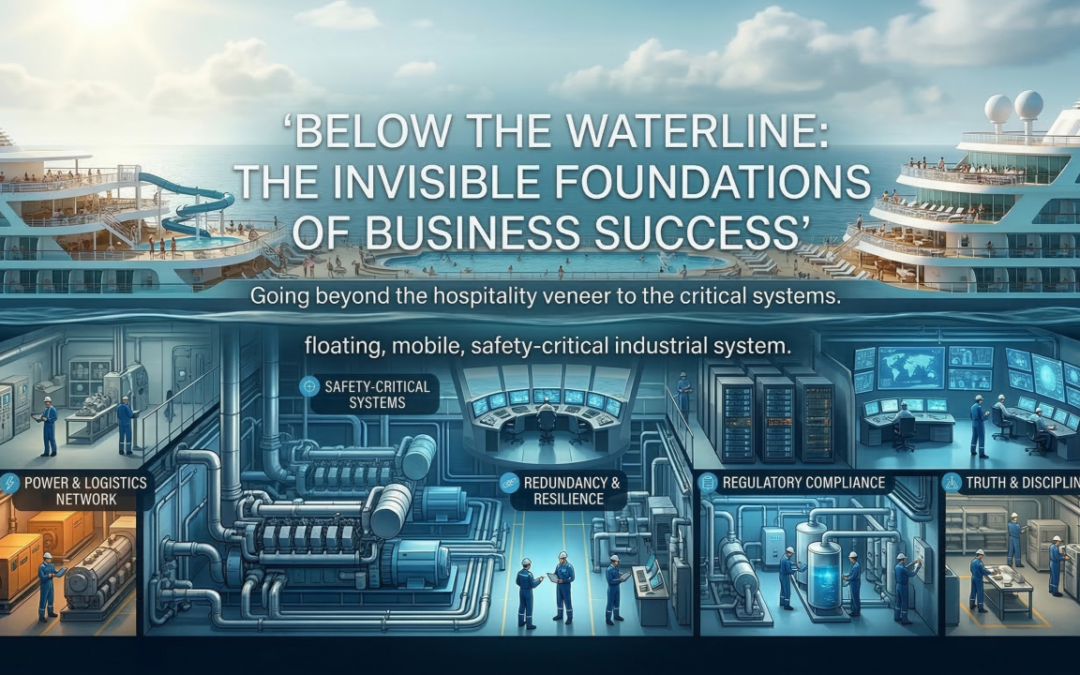
Passengers experience the cruise industry from the top decks.
Leaders experience it below the waterline — where safety, systems, and survival live.
From the outside, cruising looks like a hospitality business. Beautiful ships. Carefully choreographed experiences. Entertainment, dining, destinations, and service delivered at scale.
But that view is incomplete.
The cruise industry is not just a hospitality business — it is a floating, mobile, safety-critical industrial system. A city. A power plant. A logistics network. A regulated asset. A global brand — all operating simultaneously, continuously, and under scrutiny.
Its success depends on an operating backbone that prioritizes truth, discipline, redundancy, clarity, and resilience — long before the guest ever steps onboard.
That backbone is mostly invisible.
And that’s exactly the point.
Why Look “Below the Waterline”?
For years, I’ve described the cruise industry as a laboratory for leadership, operational excellence, resilience, growth, and navigating disruption.
Why?
Because it compresses challenges that most organizations face episodically into a constant operating reality:
- Competitive pressure
- Technology shifts
- Regulatory oversight
- Capital intensity
- Supply-chain fragility
- Geopolitical and international uncertainty
- Human factors and brand risk
At sea, these forces don’t arrive one at a time. They overlap.
There is no pause button. No luxury of denial. No room for improvisation when stakes are high.
That makes the cruise industry a uniquely honest teacher.
And the most important lessons live below deck.
This article begins a new Strategic Alchemy series — Below the Waterline — focused on what the cruise industry’s operating backbone can teach leaders in any industry about building organizations that hold together under pressure.
What “Below the Waterline” Really Means
On a ship, everything essential to survival is out of sight:
- Hull integrity
- Power generation
- Navigation systems
- Safety equipment
- Maintenance discipline
- Redundancy
- Compliance
Passengers don’t think about these things — until they fail.
The same is true in business.
Most organizations invest heavily in what’s visible:
- Brand and storytelling
- Growth initiatives
- Revenue systems
- Innovation narratives
- Leadership messaging
Far fewer invest with equal rigor in what actually determines whether the enterprise can operate safely, consistently, and credibly when conditions deteriorate.
The uncomfortable truth is this:
You don’t discover your operating backbone during disruption. You discover whether you bothered to build one.
The Illusion of Smooth Sailing
In stable conditions, weak systems can masquerade as competence.
Revenue grows. Customers are satisfied. Leaders are celebrated. Performance looks strong.
But disruption has a way of stripping away illusion.
Competitive dynamics intensify. Technology reshapes workflows. Regulatory expectations rise. Supply chains fracture. Natural events intervene. International relationships shift.
Suddenly, assumptions are tested.
Organizations that continue to perform through these pressures usually share a common trait: they have clear operational truth, disciplined systems, and decision-making structures that function under stress.
Those that don’t often discover — too late — that momentum was doing the work that design should have done all along.
The Anatomy of an Operating Backbone
When you look under the decks of a cruise operation, you don’t find a single system or department. You find an interlocking architecture designed to answer five unforgiving questions:
- Are we safe — right now?
- Are our assets fit for purpose?
- Do we know the truth about our condition?
- Can we prove compliance at any moment?
- Can we recover, adapt, and keep moving forward?
That architecture includes:
- Fleet maintenance and asset management
- Inventory and supply-chain discipline
- Procurement controls
- Safety and compliance systems
- Crew certification and readiness
- Financial and operational transparency
- Tight integration between frontline operations and leadership
These systems are not glamorous. They don’t generate headlines. They are expensive, persistent, and sometimes uncomfortable.
They are also what keep ships sailing, reputations intact, and companies viable over time.
Why This Matters Far Beyond Cruising
The lesson here is not “become a cruise company.”
The lesson is this:
Every resilient organization has a below-the-waterline reality — whether it acknowledges it or not.
Industries differ. Contexts change. Technologies evolve.
But the pattern is universal.
- In healthcare, it’s clinical safety, capacity, and continuity of care.
- In energy, it’s asset integrity, grid resilience, and redundancy.
- In finance, it’s liquidity, risk controls, and capital discipline.
- In logistics, it’s network visibility and execution reliability.
- In government, it’s operational readiness and institutional continuity.
Ignore the backbone, and growth becomes fragile. Overinvest above deck, and you create leverage without ballast.
Below the Waterline and Hard Ships
This series directly reflects the thinking behind my book Hard Ships and the Business Resilience Framework I developed from decades of navigating disruption.
The cruise industry’s operating backbone is a real-world expression of those principles:
Business Resilience Framework
- Get to the Truth: Single source of operational reality; no hiding from data
- Keep Moving While Conserving Energy: Disciplined systems over heroics
- The Keystone Activity: Safety, readiness, and operational continuity
- Question Everything: Audits, inspections, verification
- Analyze, Learn, Apply & Document: Maintenance data, feedback loops, institutional memory
- Repair & Augment Your Foundation: Modernizing core systems, not chasing surface-level fixes
Resilience is not an abstract concept. It is built — deliberately — into the foundation.
Leadership Below the Decks
The hardest leadership work rarely looks heroic. It looks like:
- Insisting on uncomfortable facts
- Funding systems no customer will ever notice
- Saying no to shortcuts that feel expedient
- Building redundancy when efficiency is fashionable
- Preparing for disruptions you cannot predict
But when disruption arrives — and it always does — those choices become the difference between resilience and regret. That is the real lesson of the cruise industry. And it is a lesson worth mining carefully — not from the bridge, but below the waterline.
What Comes Next
In the articles that follow in this Below the Waterline series, I’ll go deeper into:
- The operating backbone itself
- Why certain systems quietly dominate entire industries
- What disruption reveals about foundations we take for granted
- How AI and technology amplify structure — for better or worse
Because in business, what keeps you afloat is rarely what gets noticed. Until it fails.
A Final Thought — and an Invitation
Every organization has a below-the-waterline reality — systems, structures, and decisions that determine whether it can perform, adapt, and endure when conditions change.
If you’re leading a complex organization and wrestling with those questions — how to navigate disruption, strengthen resilience, or ensure your foundation is fit for the future — I’m happy to explore that with you.
My work over the past four decades has been spent inside real organizations, during real disruptions, helping leaders get to the truth, steady the enterprise, and move forward with confidence. If a conversation would be useful, feel free to reach out.
Onward!
Editor’s Note – Strategic Alchemy Series
This article launches a new Strategic Alchemy series: Below the Waterline.
For years, I’ve described the cruise industry as a laboratory for leadership, resilience, and navigating disruption. Not because it’s glamorous — but because it operates at the intersection of complexity, safety, regulation, capital intensity, and human factors, every single day.
This series looks beneath the surface — below the decks — to examine the operating backbone that actually keeps complex systems functioning when conditions change. It’s where truth lives, discipline matters, and resilience is built long before disruption announces itself.
While the examples come from cruising, the lessons apply far beyond it — to any leader responsible for a complex organization navigating uncertainty, growth, and change.
Each article in this series will explore a different aspect of what lives below the waterline — and what leaders in any industry can learn from it.