
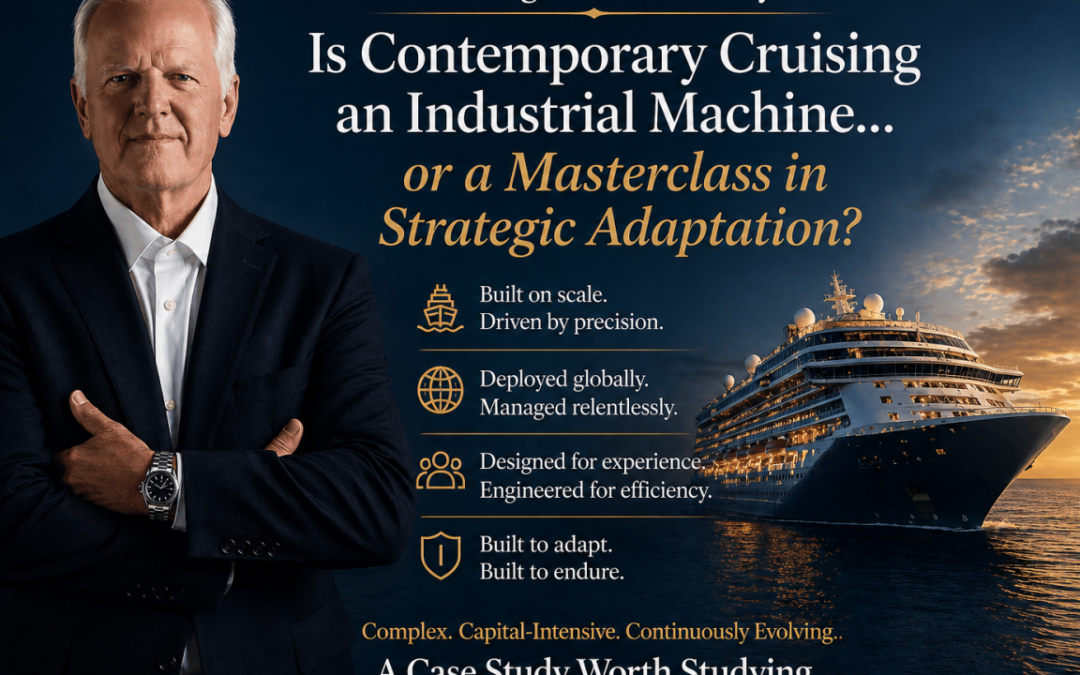
The cruise industry is often viewed through the lens of leisure, hospitality, and escape.
But what if we looked at it differently?
What if contemporary cruising—the largest and most visible segment—was actually one of the most sophisticated industrial systems in the global economy?
Because that’s exactly what it is.
And more importantly…
It’s a case study in how complex businesses operate, adapt, and survive at the intersection of scale, disruption, and customer expectation.
The Industrial Engine of Experience
At its core, contemporary cruising is a capacity-driven business.
Ships are not just assets—they are floating cities with fixed cost structures that demand continuous utilization.
Once a ship is built:
- The capital is committed
- The cost base is largely fixed
- The clock starts ticking
Every sailing that departs with empty cabins represents perishable inventory lost forever.
This creates a simple but unforgiving equation:
Fill the ship. Optimize the yield. Repeat—relentlessly.
This is not unlike airlines or hotels—but with far greater complexity.
Because a cruise line is simultaneously managing:
- Transportation
- Hospitality
- Food & beverage
- Entertainment
- Destination experiences
- Retail
- Logistics
All within a single, self-contained ecosystem.
Scale vs. Experience: The Central Tension
The defining challenge in contemporary cruising is this:
How do you scale massively…without commoditizing the experience?
The largest ships in the world now carry:
- 5,000–7,000 guests
- 2,000+ crew
- Entire neighborhoods, not just decks
Scale creates efficiency.
But scale also creates risk:
- Loss of intimacy
- Operational complexity
- Brand dilution
The winners in this category are those who have learned to engineer experience within scale.
Not reduce it.
The Strategic Shift: From Ships to Ecosystems
One of the most important—and underappreciated—developments in contemporary cruising is the move toward vertical integration of the experience.
Private destinations are the clearest example:
- Royal Caribbean’s Perfect Day at CocoCay
- NCL’s Great Stirrup Cay
- Carnival’s Celebration Key (emerging)
These are not just “ports of call.”
They are:
- Controlled environments
- Margin-enhancing assets
- Brand extensions
- Demand drivers
In effect, cruise lines are shifting from:
Selling itineraries → to owning ecosystems
This changes the economics dramatically:
- Higher margins
- Greater control of guest experience
- Reduced dependency on third-party destinations
It’s a strategic move that mirrors broader trends in other industries:
- Vertical integration
- Platform control
- Experience ownership
Deployment: The Hidden Chess Game
Behind the scenes, one of the most critical strategic levers is fleet deployment.
Where a ship goes—and when—is not a logistical decision.
It’s a capital allocation decision in motion.
Consider:
- Caribbean = high volume, consistent demand, operational efficiency
- Mediterranean = higher yield, higher complexity
- Alaska = regulated supply, premium pricing
- Emerging markets = growth potential with uncertainty
Every repositioning is a bet on:
- Demand
- Pricing power
- Geopolitical stability
- Competitive dynamics
Done well, it drives outsized returns.
Done poorly, it erodes margins quickly.
The Resilience Factor
Few industries have been tested like cruising.
The pandemic was not just a disruption—it was an existential event.
And yet, the industry demonstrated something important:
A steady state of disruption requires a steady state of resilience.
Balance sheets were restructured. Fleets were rationalized. New ships were ordered—during the storm.
That last point matters.
While the world questioned survival, the industry was already building for the future.
That’s not luck.
That’s strategic conviction.
What This Really Teaches Us
Contemporary cruising is not just about vacations.
It’s about:
- Managing fixed-cost intensity
- Balancing scale with differentiation
- Engineering demand
- Controlling the value chain
- Adapting under extreme pressure
In other words…
It is a masterclass in operating a complex, capital-intensive business in a volatile world.
The Broader Insight
If you step back, the implications go far beyond cruising.
Many industries are facing similar dynamics:
- High fixed costs
- Rising customer expectations
- Need for differentiation at scale
- Increasing pressure to control the experience
The cruise industry has simply been forced to confront these realities earlier—and more intensely—than most.
Final Thought
There is a tendency to underestimate industries that deliver “experiences.”
To view them as soft, discretionary, or secondary.
That’s a mistake.
Because beneath the surface, you often find some of the most sophisticated strategic thinking anywhere in business.
Cruising is one of those industries.
And it has a lot to teach—if you’re willing to look at it the right way.
Onward!
This is a continuation in the Strategic Alchemy series exploring “Cruising as a Case Study”—a living laboratory for disruption, resilience, and reinvention.
Let’s connect to explore how my advisory services can help you uncover and capitalize on your brightest opportunities.
𝐃𝐚𝐯𝐢𝐝 𝐆𝐢𝐞𝐫𝐬𝐝𝐨𝐫𝐟 is the Founder of Global Voyages Group, a strategic advisory firm serving the cruise industry. A forty-year cruise industry veteran, he is the author of Hard Ships and the creator of the Strategic Alchemy platform. “I’ve invested over 100,000 hours—ten times Malcolm Gladwell’s 10,000-hour rule—building, leading, acquiring, and selling businesses across the global cruise and travel industry and the marketing and data sectors. My career spans operational leadership, strategic transformation, M&A, and turning around underperforming assets into market leaders. I’ve led teams from dozens to thousands, managed P&Ls, driven billions in revenue, and navigated organizations through growth, crisis, and fundamental reinvention. I now advise executives and organizations on strategy, leadership, resilience, and transformation through complexity, helping leaders move from survival to systematic excellence.”